





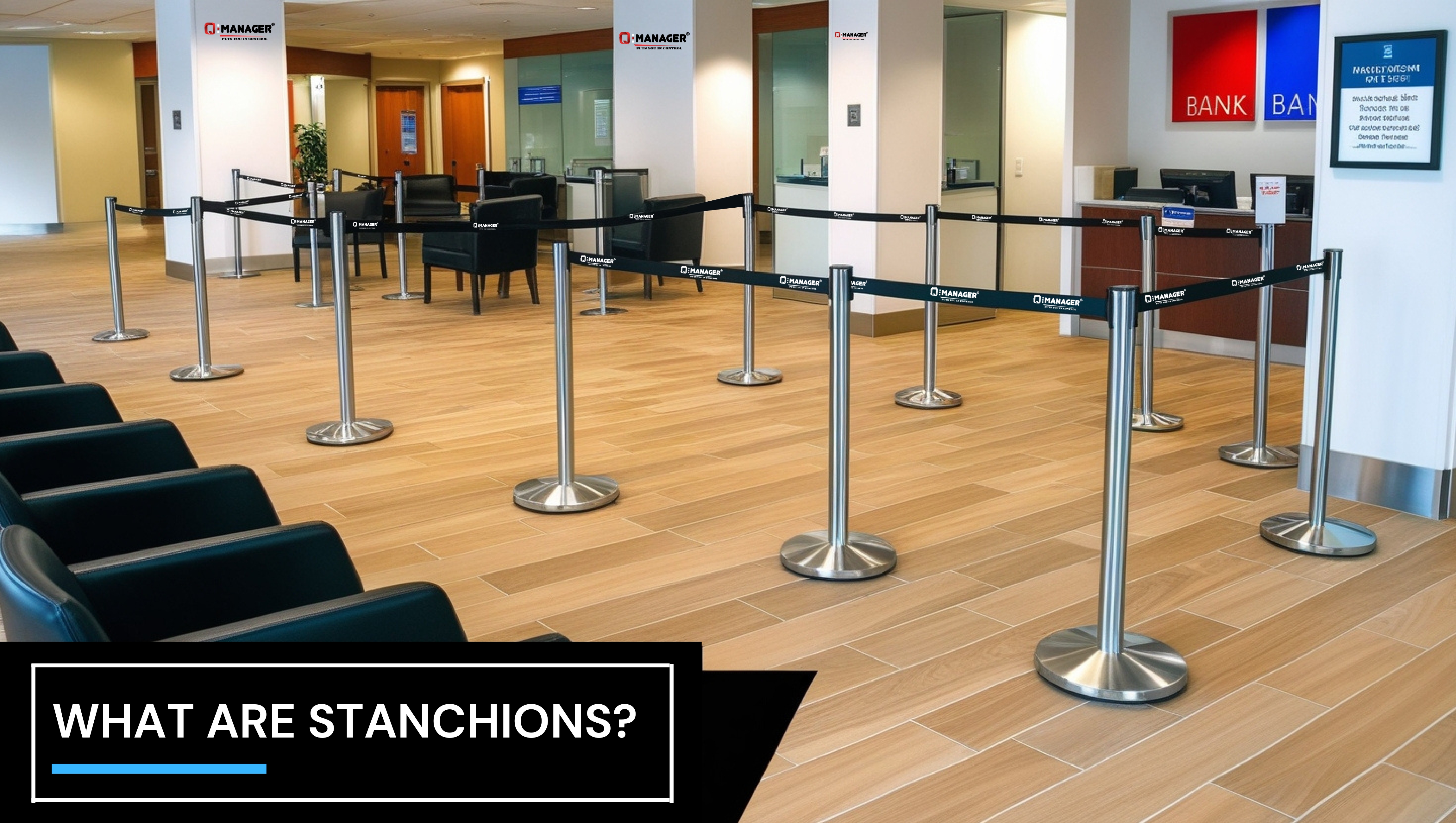
A stanchion is an upright post that holds a retractable belt, rope, or chain to guide people and control queues. In commercial spaces, these posts make up the main structure of a queue barrier. Retractable belt versions suit functional queues, while rope versions suit entrances where presentation matters as much as directing visitors.
The buying mistake to avoid? Choosing the post’s appearance before checking how the complete barrier will work.
What is a Stanchion? (The Exact Definition)
A stanchion is simply an upright post used to support or guide a barrier system. In a business context discussing crowd control, it means the queue barrier pole.
The difference is straightforward: the stanchion is the post, while the queue barrier is the complete setup. A belt, rope, or chain connects the posts and guides people through the space
That matters when ordering. Don’t assume a quotation for “stanchions” includes every component needed for your layout. Ask the supplier to identify the bases, belts or ropes, and connectors included.
Read This Article: queue barrier vs stanchion
The Main Types of Queue Stanchions
There are two main configurations worth knowing before you start comparing products.
Retractable Belt Stanchions
Retractable belt stanchions use a belt housed in a cassette. Pull it out, connect it to a compatible receiver, and you have a defined queue lane. When released, the belt retracts automatically into its housing; staff should follow the manufacturer’s instructions rather than let it snap back.
For banks, airports, and other high-traffic service areas, this is the type we recommend shortlisting first.
The connection is quick to change, and there is no separate rope to store when opening a lane. But check the mechanism in person: extend the belt, attach it, release it, and observe the retraction.
For airport queue efficiency, focus on the route rather than just the hardware. Mark the entrance, turns, service points, and staff openings before deciding how many posts to buy. Stanchions organise waiting space; they do not increase processing capacity at a counter.
PRODUCT LINK: retractable belt stanchions
Classic Rope Stanchions
Rope stanchions connect posts with separate ropes and end fittings. They suit VIP entrances, red carpets, and hospitality areas where the barrier is part of the presentation.
Choose the post finish and rope together. A product photograph of the post alone does not show how the complete installation will look.
For a frequently reconfigured queue, we suggest favouring belts. Rope barriers make more sense when appearance takes priority, and staff are prepared to handle and store the ropes.
Why Material Matters (SS 304 vs Cheap Plastic)
We manufacture premium SS 304 stanchions for heavy-duty commercial queue applications.
Still, steel grade is not a stability rating.
Tipping resistance depends on the assembled design, including the base’s weight and footprint, the post height, and the forces applied through the belt or rope. No ordinary freestanding queue post is impossible to tip over.
Our standard queue posts use heavily weighted bases, with base diameters around 320–350 mm, to improve stability and prevent tipping.
For a permanent, busy indoor queue, we would not choose a lightweight plastic post simply to reduce the purchase price. Please ask for a sample of the assembly. Then check the stability of that assembly, the connections of that assembly, and how easy it is to reposition that assembly in the intended location.
Plastic is not automatically unsuitable for every application. Plastic remains an option in many situations. But a lightweight temporary marker is a different purchase from a commercial queue post expected to withstand repeated daily handling.
Ask which components are SS 304, too. The post’s material specification does not establish the material of its base or cover.
Where Are Stanchions Used?
The setting tells you what to prioritise:
Before ordering, walk the proposed route with the people who will operate it. Include access needs, nearby doors, and the space required to move posts when the queue closes. Resolve those practical details before approving quantities.
Ready to specify your queue posts?
Now that you know what a stanchion is, view our catalogue of premium queue stanchions. Send a measured sketch with your enquiry and request an itemised recommendation covering posts, bases, connections, and any necessary accessories.
Check out our premium queue stanchion catalogue
B2B Pricing Guide: What Should Your Stanchion Quote Include?
Start with a shared specification. A price per post is only useful when competing quotations include the same components and meet the same requirements.
|
Quotation item |
What to ask the supplier to specify |
Why it matters when comparing prices |
|
Post and base |
Materials, dimensions, base construction, and assembly weight |
Similar-looking posts need not have equivalent construction |
|
Retractable belt assembly |
Belt length and width, cassette, receiver, and release mechanism |
Establishes what the quoted belt configuration includes |
|
Rope and fittings |
Rope specification, length, end fittings, and compatible posts |
Confirms whether the quote includes complete connections |
|
Accessories |
Sign holders, wall receivers, and other required fittings |
Prevents necessary accessories from being mistaken for optional extras |
|
Quantity |
An itemised count tied to the proposed layout |
Makes quotations comparable against one arrangement |
|
Delivery and assembly |
Freight, assembly responsibilities, and any installation charges |
Separates equipment pricing from fulfilment costs |
|
Taxes |
Applicable taxes and whether they are included |
Allows comparison of the final payable totals |
|
Warranty and replacement parts |
Written coverage, exclusions, parts availability, and quoted replacement costs |
Helps assess maintenance provisions beyond the initial purchase |
Compare complete systems, not headline prices
Ask for two totals: the equipment cost and the final amount you’ll pay, including delivery, services, and taxes.
For belt systems, ask whether the cassette is replaceable and request its current replacement price. For rope systems, confirm whether individual ropes and fittings are available separately. Do not assume either provision.
Use this enquiry wording:
Please quote for a complete queue barrier system based on the attached layout. Itemise posts, bases, belts or ropes, connectors, and required accessories. State the material of each major component, delivery charges, applicable taxes, assembly scope, warranty terms, and replacement-part availability. Identify any exclusions and confirm the quotation’s validity period.
Before approving the order, have operations sign off on the layout and procurement check the itemised scope. That is a better buying discipline than selecting the lowest price per post.
 Info@q-manager.com
 +91-9910398700